Custom Cabinets in Thousand Oaks, CA
Quick Take: Custom cabinets are not the right call for every kitchen. Semi-custom is not a consolation prize either. In Thousand Oaks, where a lot of homes go back to the 1970s and 1980s, the layout of your house usually makes this decision for you. This guide helps you figure out which one fits.
Cabinets eat up a big chunk of any kitchen budget. We are talking 30 to 40 percent in most cases. So before you fall in love with a finish or a wood color, it helps to know what you are actually choosing between. Custom and semi-custom are not the same thing, and the difference goes beyond price.
Most homeowners figure this out halfway through the process, which is the worst time to figure it out. Getting clear on it now saves you from backtracking later. Read through this, and you will know exactly where you stand before your first consultation.
What "Custom" Actually Means (and What It Doesn't)
People throw this word around a lot. Walk into any showroom and everything sounds custom. It is not. There are really three levels, and they are very different from each other.
Stock cabinets come pre-built. They sit in a warehouse until someone orders them. Sizes are fixed, options are limited, and you adjust your kitchen around them. They are the most affordable option, but you give up a lot of control.
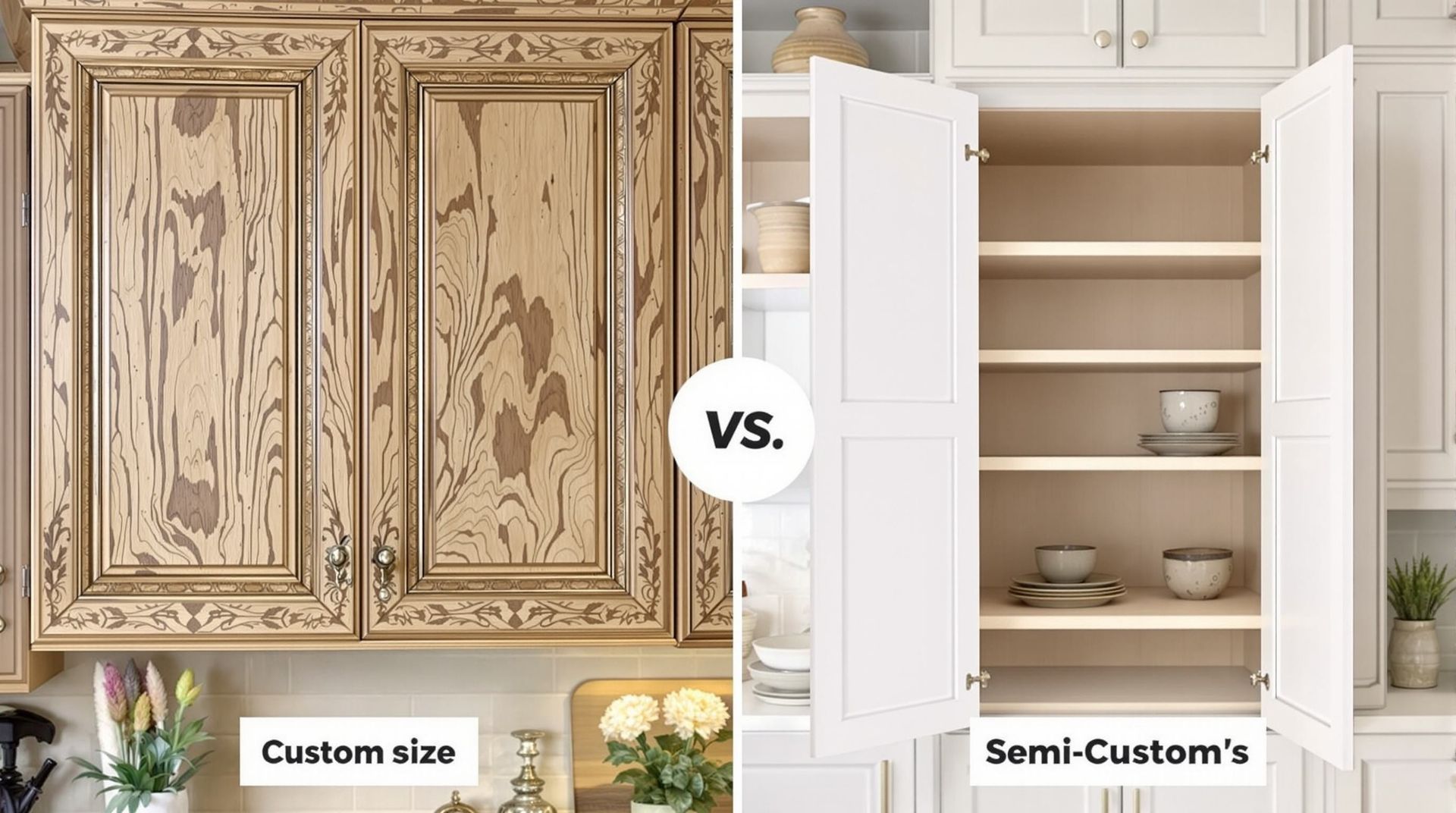
Semi-custom cabinets are made after you order them. You pick from a set menu of sizes, finishes, and features. More flexibility than stock, but still within a defined range. For kitchens with a fairly normal layout, this is where most people land.
Full custom cabinets are built around your exact space. No preset sizes, no workarounds. Your designer measures your kitchen and the cabinets are made to fit it perfectly. For homeowners in the Conejo Valley looking at kitchen cabinets in homes with tricky layouts, that precision matters a lot.
How Semi-Custom Cabinets Work
Semi-custom gets a bad reputation it does not deserve. A lot of people assume it means settling. It does not. You still get real choices, and the results can look just as sharp as full custom when the design is done right.
Size and Configuration Options
Sizes go up in three-inch steps. That covers most standard kitchens without a problem. You can also add things like pull-out shelves, soft-close hinges, and built-in organizers. The options depend on the brand, but a good semi-custom line gives you a lot to work with.
Finish and Hardware Selections
Most semi-custom lines offer painted, stained, and glazed finishes in several wood species. Hardware runs from simple brushed nickel to brass and matte black. You are not stuck with one look. For homeowners who want the kitchen to feel personal without the full custom price tag, semi-custom covers a lot of ground.
Where Custom Cabinets Make the Difference
Here is the honest answer: your house decides. Semi-custom works great in a clean, standard kitchen. But plenty of homes in the Conejo Valley were built 40 or 50 years ago. Walls are not always square. Ceilings do strange things. Soffits show up in inconvenient places. That is where semi-custom starts to struggle.
Custom is worth the extra cost in these situations.
- Your kitchen has angled walls or an odd shape: Semi-custom sizes leave gaps in corners and along walls. Custom cabinets are built to fill every inch of your actual space.
- You have soffits or a dropped ceiling: Working around these with standard sizes usually means ugly filler strips. Custom removes that problem entirely.
- You want to go floor to ceiling: Pre-set heights cap what you can do. Custom builds use every inch of vertical space you have.
- The whole layout is changing: Moving walls means nothing is standard anymore. Homeowners doing a full kitchen remodeling project almost always find custom pays off when the footprint has shifted.
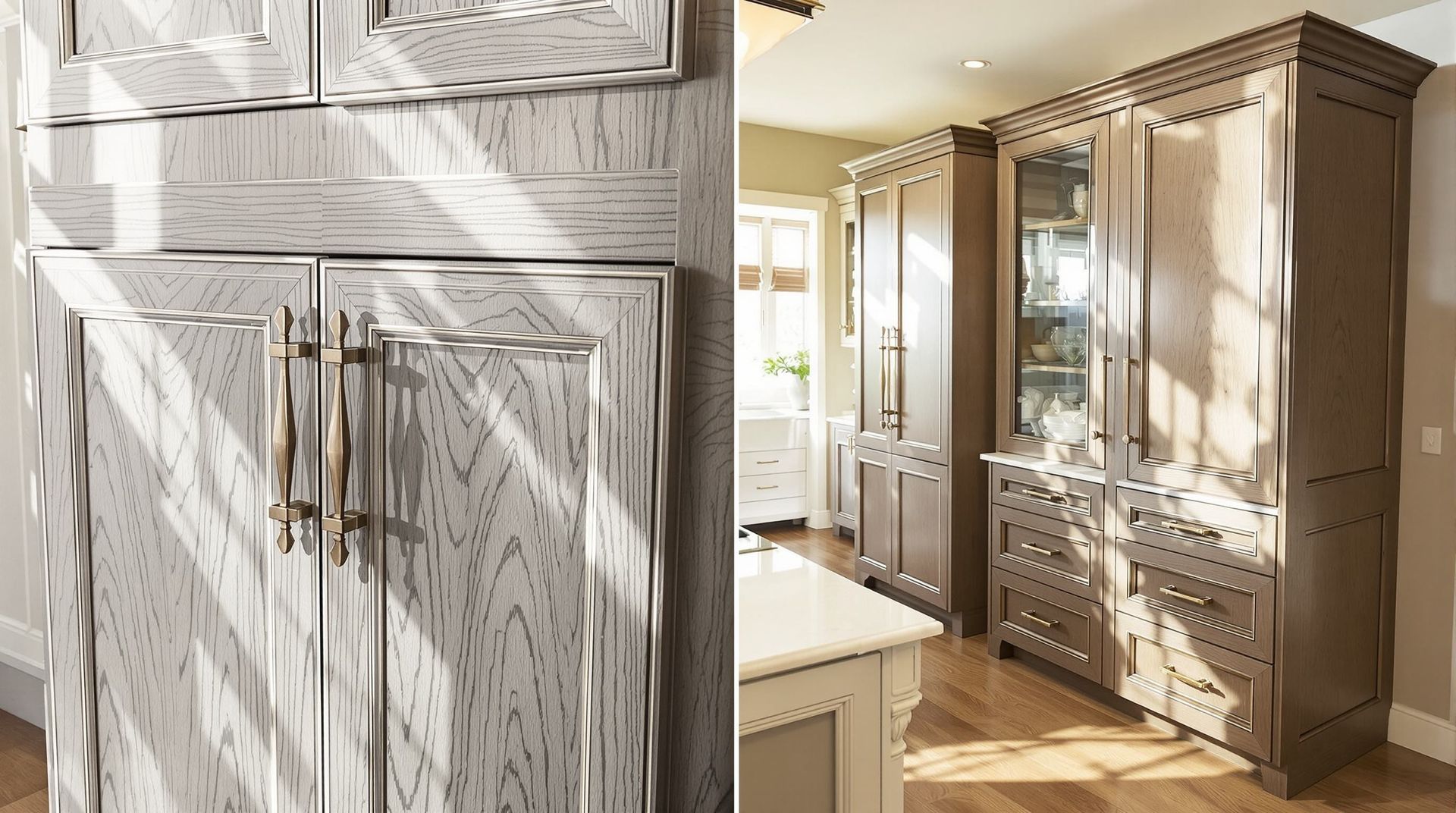
We carry Dura Supreme cabinetry at our showroom. It is a premium semi-custom line with far more wood species, finishes, and storage options than most brands in this category offer. It is a strong middle ground for homeowners who want high-end results without a fully custom build.
Breaking Down the Cost Difference
Let's talk numbers. In the Conejo Valley, semi-custom cabinets run from about $200 to $650 per linear foot installed. That lower end reflects simpler finishes and basic configurations. Full custom starts around $500 per linear foot and goes up from there depending on materials and complexity.
The gap between the two can shrink fast. Add upgraded hardware, specialty finishes, and extra storage features to a semi-custom order and you can end up close to custom pricing. Know what you are adding before you commit to either path.
Older homes bring their own surprises. Once the old cabinets come out, it is not unusual to find outdated plumbing or wiring behind them. That adds cost that has nothing to do with your cabinet choice. Build a buffer into your budget. Ten to fifteen percent is a reasonable cushion for a home built before 1990.
Ask for an itemized proposal before anything gets ordered. A line-by-line breakdown shows you exactly where the money goes and protects you if the scope changes down the road.
Wood Species, Hardware, and the Choices That Add Up
Once you pick a cabinet type, you still have a list of decisions ahead. Wood species and hardware seem like small details. Over time, they are not.
Wood species affects the look, the texture, and how long the cabinets hold up. Here is a quick breakdown of the most common options.
- Maple: Smooth grain, takes paint really well. A top pick for modern and transitional kitchens.
- Cherry: Warm, rich color that gets deeper with age. Works well in traditional spaces.
- Oak: Open grain, classic look, very durable. Holds up well in busy kitchens.
- Alder: Softer wood with a subtle grain. Good for painted finishes when you want to keep costs in check.
Hardware is one of those things people underestimate. You open and close cabinet doors and drawers dozens of times a day. Cheap hinges and drawer slides show their age fast. Soft-close mechanisms are worth adding no matter which cabinet level you choose.
Swatches and photos only go so far. Seeing real samples in person is a different experience. Our Newbury Park showroom has wood species, finishes, and hardware on display so you can see and feel everything before committing. Our team can walk you through it all as part of our kitchen and bath design services before a single cabinet gets ordered.
How to Decide Which Option Is Right for Your Home
Skip the comparison charts. Three things make this decision pretty clear once you think them through.
First, look at your actual kitchen. Standard dimensions and a clean layout? Semi-custom will work. Odd angles, low ceilings, or anything that does not fit a normal box? You are likely looking at custom.
Second, check your timeline. Semi-custom ships in four to six weeks after the order. Full custom can take eight to twelve weeks or more. If your kitchen remodeling has a hard end date, that lead time matters.
Third, think about how long you plan to stay. If you are in this house for the next 15 or 20 years, custom cabinets tend to pay for themselves. That logic holds for bathroom remodeling too. Storage and fit matter just as much in a bathroom as they do in a kitchen.
Still not sure? A free consultation with our team is the fastest way to get an honest answer for your specific space.
Conclusion
No two kitchens are the same. A family in a 1985 split-level with a tight galley layout has a different set of needs than someone opening up a first floor and starting fresh. The cabinet choice that makes sense for one project can be completely wrong for another.
Westside Remodeling has been working through these decisions with Conejo Valley homeowners for nearly 40 years. We are not here to sell you the most expensive option. We are here to help you find the one that actually fits your home, your budget, and how you live in the space.
Come see us at the showroom in Newbury Park or start a conversation. Either way, we can help you get clear on what makes sense before anything gets ordered.